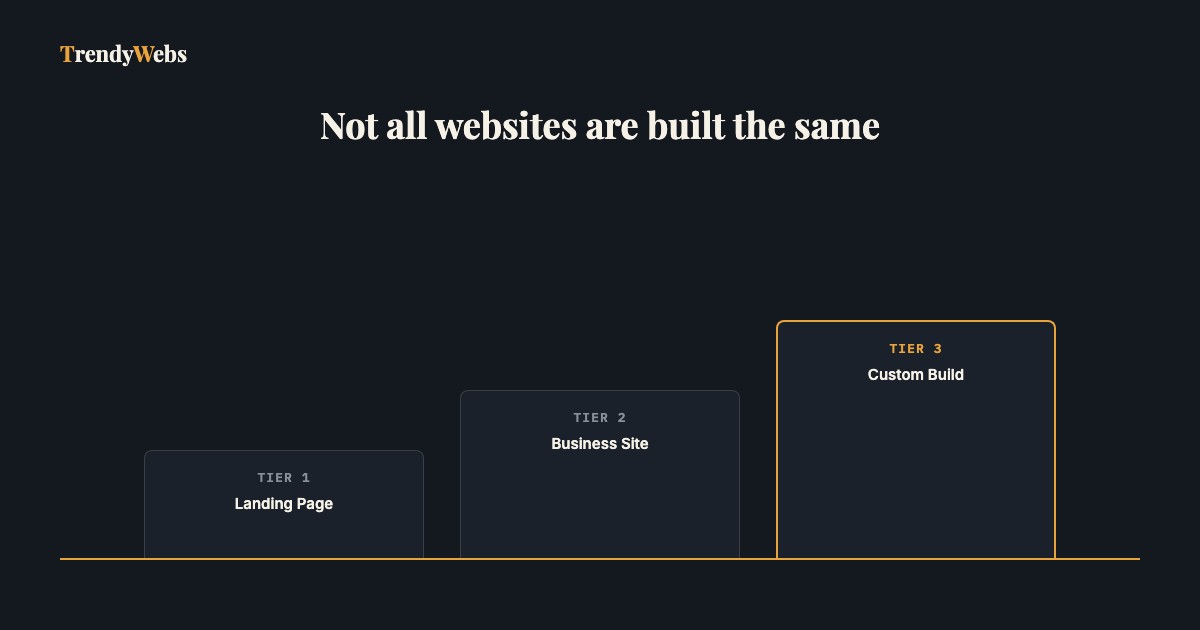
"How much does a website cost" is one of the most asked, and most unanswerable-as-asked, questions in this business. Search for it and you'll find quotes anywhere from a few thousand rupees to several lakhs, for what sounds on the surface like the same product. It isn't a pricing mystery. It's an incomplete question, because "a website" describes dozens of genuinely different things.
Custom-built versus template. A templated site starts from an existing design and adapts it, faster and cheaper, but limited in how much it can be shaped around your actual brand and how you convert visitors. A custom build starts from your business specifically, more expensive, but built to do exactly what you need rather than what the template allows.
Page count and structure. A single landing page is a different scope of work than a full business site with service pages, a blog, and a portfolio, which is a different scope again from something like a 40-page corporate site covering multiple service lines (we've built one this size, for an Australia-based managed services company, structured around dozens of distinct capability areas).
E-commerce or backend complexity. A site that just presents information costs less than one that needs to handle a product catalogue, payments, inventory, or user accounts. Backend complexity is usually where budgets move the most.
What's built in versus bolted on. Page speed optimisation, SEO-ready architecture, and analytics tracking (GA4, Tag Manager, Search Console) either get built in from day one or get retrofitted later, usually at greater total cost than building them in from the start.
These are directional, not quotes, every project's actual price depends on the specifics above. But as a starting frame for where different kinds of builds tend to land:
A slow, generic, template-locked website is a leak in every campaign built to point traffic at it. The most expensive website isn't usually the one with the highest upfront price, it's the one that has to be rebuilt in eighteen months because it was never built on a foundation that could support real SEO or real conversion work in the first place. That rebuild costs the original price again, plus the marketing spend that underperformed in the meantime.
This doesn't mean every business needs the most expensive option. A business that genuinely needs a simple, low-maintenance presence and nothing more is well served by a lean, inexpensive build, that's not a false economy. The mismatch only happens when a cheap site is expected to carry real marketing weight it was never built to handle.
The only way to get an accurate quote, from us or anyone else, is to describe the scope: how many pages, what the site needs to do beyond exist, whether there's e-commerce or backend logic involved, and what already exists versus what's being built from scratch. Anyone who quotes a firm number before asking those questions is quoting blind.
Because "a website" isn't one product. A five-page template site and a custom-built site with the same page count involve completely different amounts of work, and the word website covers both. The gap in price is almost always a gap in scope, not just a gap in vendor pricing.
Sometimes, if the business genuinely needs a simple placeholder presence and nothing more, a lean, inexpensive build is the right call, not a false economy. The risk is only when a cheap site is expected to carry real marketing weight, SEO, conversion, brand credibility, that it wasn't built to handle.
No, price alone isn't a reliable signal either way. What matters is whether the scope and price match: a custom, page-speed-optimised, conversion-focused build should cost more than a template, but a high price with no clear reason behind it is just as much a red flag as a suspiciously low one.