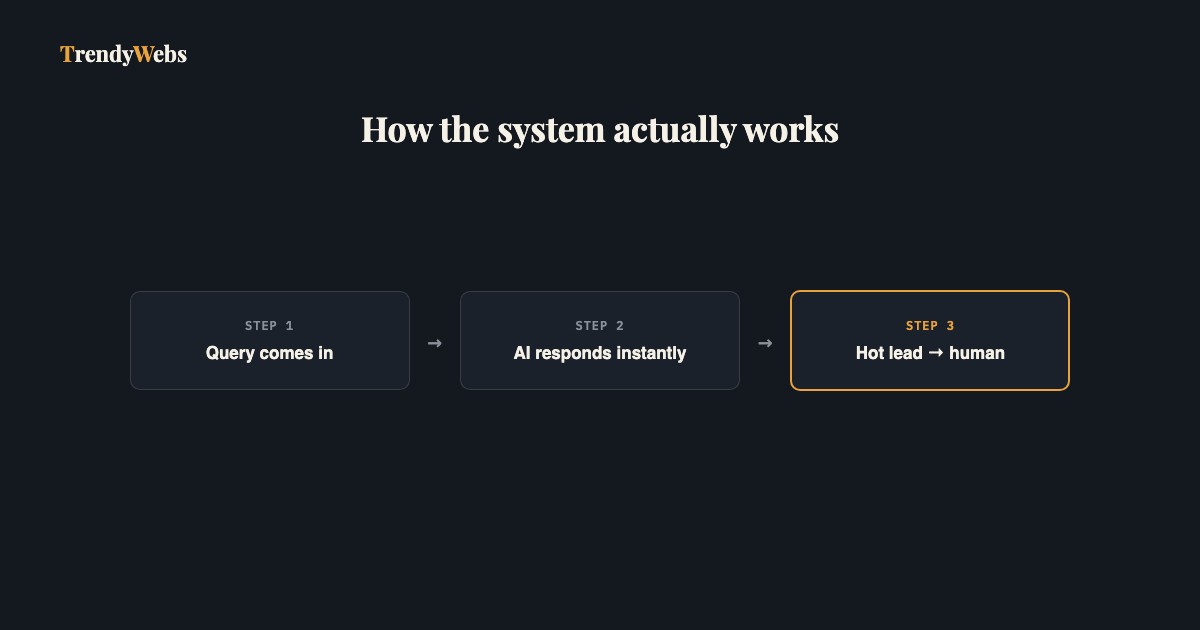
Most people hear "WhatsApp automation" and picture flipping a switch, a chatbot appears, and the problem is solved. It's a reasonable thing to assume, and it's wrong. What makes a WhatsApp automation system work has very little to do with the chatbot part and almost everything to do with what happens before and after it.
We've built this for a hospital losing 50 to 60% of its daily patient queries to an overwhelmed front-desk team, and for a premium gym trying to make sure every lead got an instant, trackable response instead of sitting in someone's inbox. The pattern was the same both times, and it wasn't the chatbot that made the difference.
API access, done properly. A real WhatsApp Business API integration, not a personal number with auto-replies bolted on, gives a business a scalable channel that can handle real query volume without falling over. This part is mostly a setup task, it doesn't take long once a provider is chosen.
Mapping the real questions people ask. This is the part that takes real time and the part most automation projects skip. Generic chatbot scripts fail because they're built around what a business assumes customers ask, not what they ask. Getting this right means going through real query history and building response logic around the real shape of the conversations, not a generic FAQ script.
A clear rule for what gets escalated to a human. Automation should catch and qualify, not replace judgment entirely. A genuine hot lead, someone ready to book, someone asking something automation can't answer well, needs a fast, clear path to a real person. The systems that fail are the ones where automation quietly becomes the entire conversation instead of the first thirty seconds of it.
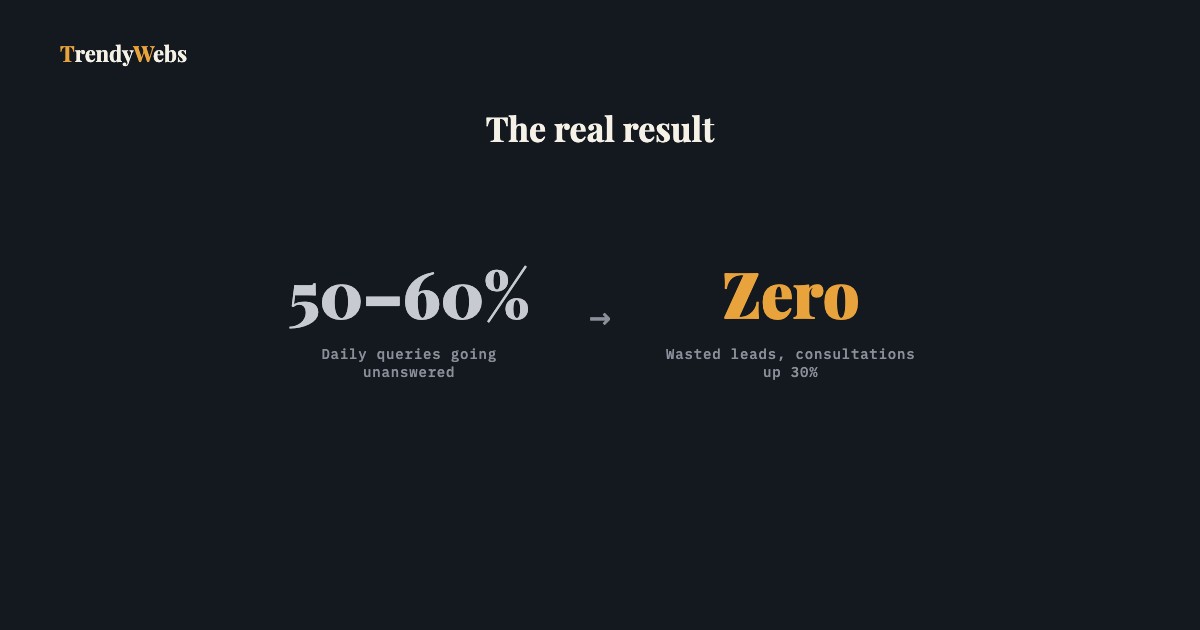
For the hospital, the real problem wasn't a lack of interest, it was response time. Patients reaching out daily about consultations and availability were going unanswered simply because the sales team couldn't keep pace with volume. The fix wasn't more staff, it was a system that made sure every genuine query got an instant, useful response the moment it arrived, with the ones that needed a human getting routed there fast.
For the gym, the same logic applied to leads instead of patients. Every inquiry got an instant, trackable response the moment it came in, and automation handled the FAQs so no inquiry sat unanswered overnight or over a weekend, exactly the gap where leads usually go cold.
The businesses that get real value from WhatsApp automation treat it the same way they'd treat any other piece of infrastructure: something that gets built deliberately around how their actual customers behave, then monitored and adjusted as real conversations reveal gaps in the logic. The ones that get disappointed are usually the ones that expected a generic setup to work out of the box, without the mapping work that makes it match how people ask questions in their specific business.
No, and it shouldn't try to. Automation handles instant acknowledgment, FAQs, and routing, but a genuinely hot lead still needs to reach a real person quickly. The goal is making sure no query goes cold while waiting, not removing the human step entirely.
It depends on how many query types need mapping and how complex the handoff to your team is, but the API access and integration itself is usually the fast part. Mapping the real questions your customers ask, and getting the response logic right, is what takes the real time.
It matters most wherever a delayed response has a real cost, a missed patient query, a cold lead that goes to a competitor. That can happen at low volume too, a business with 20 queries a day can lose just as much to slow response time as one with 200.