Most businesses treat a one-star review the way they'd treat a rude customer in person: get through it, move on, don't dwell on it. The problem is a bad review doesn't behave like a bad in-person interaction. It doesn't end when the moment passes. It sits there, indexed, searchable, and readable by everyone who considers the business afterward, for months or years.
And what most businesses get wrong isn't the review itself. It's what they do, or don't do, next.
When someone leaves a one-star review, they're not really writing to the business anymore, the transaction that upset them is already over. They're writing to every future customer who reads it before deciding whether to book, buy, or call. That audience isn't reading the complaint in isolation, they're reading the complaint alongside whatever response is, or isn't, sitting underneath it.
A well-handled response can neutralize a bad review almost entirely. An ignored one does the opposite, it turns a single customer's bad day into evidence that nobody's watching.
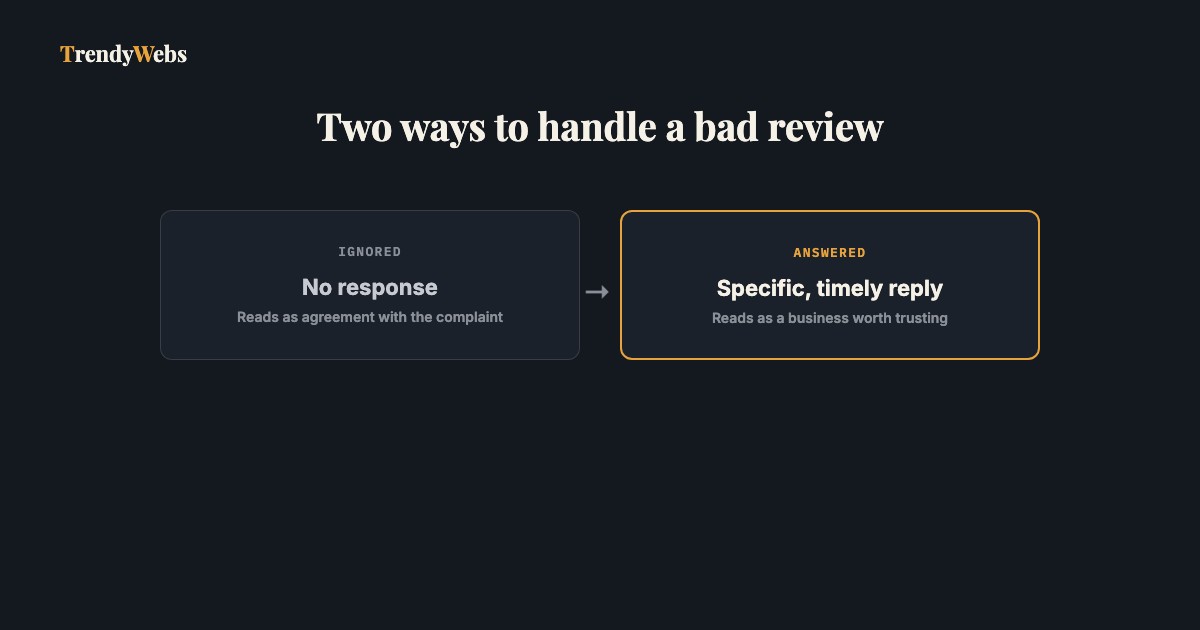
No response doesn't read as neutral. To someone scrolling through reviews trying to decide whether to trust a business, unanswered negative reviews read as confirmation, as if the business either agrees with the complaint or doesn't care enough to engage with it. Neither is the message most businesses want to send, but silence is the message that gets received by default.
This compounds over time. One unanswered bad review is a data point. A pattern of unanswered bad reviews, next to reviews that never get engaged with either way, starts to look like a business that isn't actively run, whether or not that's true.
A generic, defensive, or copy-pasted response is barely better than no response at all, readers can tell the difference immediately. A response that works is specific to the complaint, acknowledges what went wrong without being combative, and states plainly what happens next, a refund, a fix, an invitation to discuss it directly. It doesn't need to win the argument in public. It needs to show a future customer that if something goes wrong for them too, someone will deal with it.
This is also where speed matters less than people assume. Responding within a day or two is a reasonable bar. The real damage isn't the delay itself, it's a review that's been sitting unanswered for months, which reads as abandonment rather than a business that was simply busy that week.
A business with a handful of well-handled negative reviews, each with a thoughtful, specific response, often reads as more trustworthy than one with a spotless five-star record and zero engagement anywhere. Perfect ratings with no visible activity can look manufactured. Real reviews with real, professional responses look like a business people can reach.
This is the part that most reputation advice misses: the goal was never a perfect score. It's a pattern that shows up consistently enough that a prospective customer trusts what they're seeing, whether the review in front of them is the fifth glowing one in a row or the one bad day handled well.
The businesses that handle this well don't treat it as a fire drill every time a bad review appears. They build a standing habit: daily or weekly monitoring across every platform that matters, a clear internal process for who responds and how fast, and a consistent voice so responses don't read as coming from three different people with three different tones. Once that habit exists, a bad review stops being a crisis and becomes just another thing that gets handled, the same day, the same way, every time.
Ideally yes. Responding to positive reviews costs almost nothing and reinforces that someone is paying attention, it's the negative ones where a response changes minds, but consistency across both builds the pattern that matters.
Respond professionally regardless, factually correcting the record without getting defensive. Most platforms have a process to flag reviews that violate guidelines, but that process is slow, a calm public response in the meantime does more for your credibility than waiting it out silently.
Within a day or two is the realistic bar for most businesses. The damage isn't usually about the exact hour, it's about whether a prospective customer scrolling through reviews six weeks later sees a pattern of engagement or a pattern of silence.