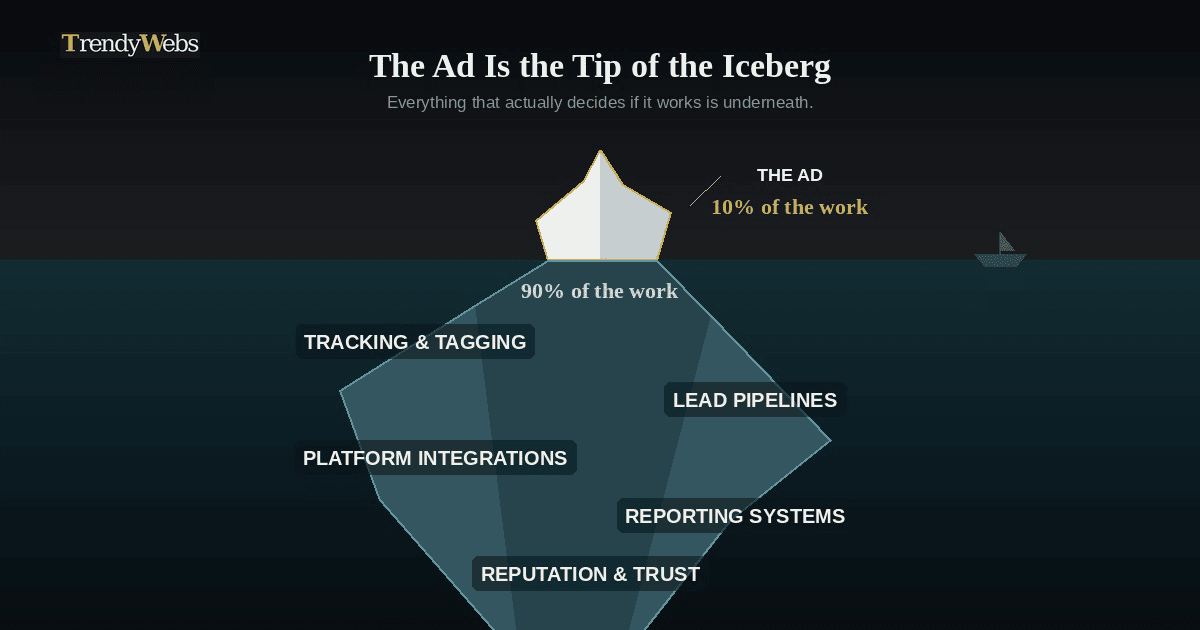
A client came to us once convinced their ad creative was the problem. Cost per lead had doubled in two weeks, and they'd already rewritten the copy twice. The creative was fine. A tracking pixel had quietly stopped firing ten days earlier, so the ad platform was optimizing toward an empty signal instead of real conversions. Nobody caught it, because nobody was watching anything except the ads.
This happens more often than most people expect. When a campaign underperforms, the ad is the first thing anyone blames, because it's the only part anyone can see. Tracking, lead handoff, and reporting sit quietly behind it, and when one of them breaks, it looks exactly like a creative problem.
A well-made ad sent to a page with no conversion tracking still fails, and you won't know why until someone goes looking. Most "the ads aren't working" conversations turn out to be "something behind the ads broke" conversations. They just never get diagnosed that way, because the failure is invisible until someone checks.
This is why every engagement starts with tracking and infrastructure, before a single rupee of new spend goes anywhere. We want to know a click can be followed through to a lead, a sale, or a booked call, without a gap anywhere in that chain.
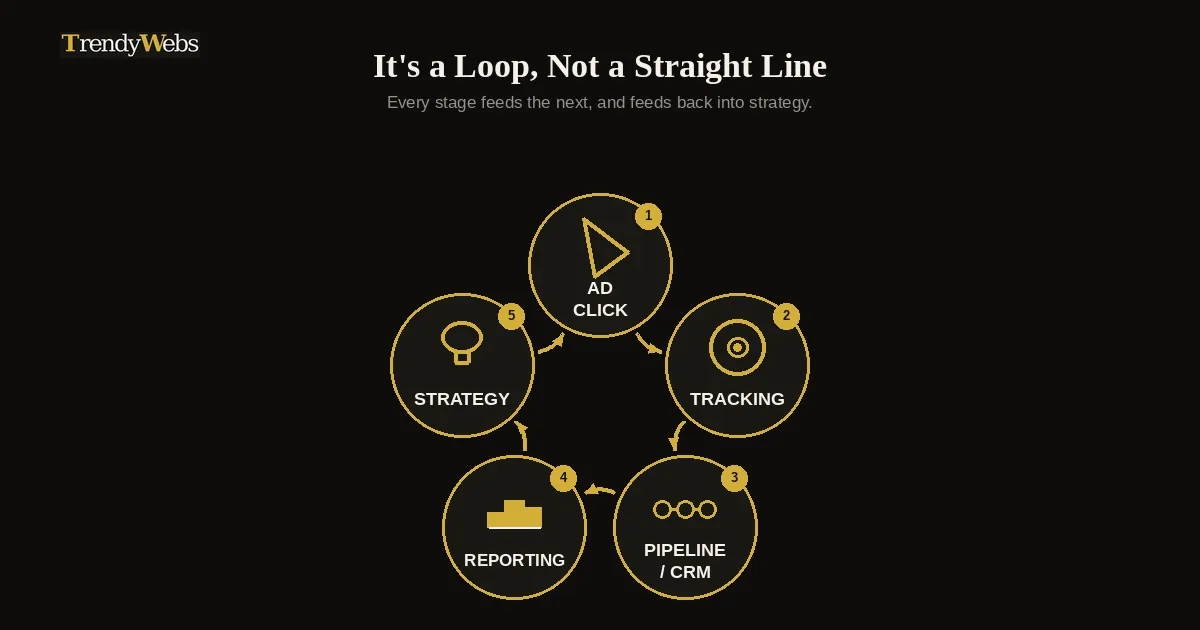
Tracking. Google Analytics 4, Google Tag Manager, Meta Pixel or Conversions API, Search Console, wired together so data isn't scattered across platforms that don't talk to each other. Skip this and every later decision is a guess wearing a strategy's clothes.
What happens after the lead. A filled-in form is the start of a second process, not the finish line. Does it land in a CRM, a spreadsheet, or an inbox nobody checks on weekends? We've watched campaigns with a great cost-per-lead quietly fail because follow-up took four days instead of four minutes, and the spend that generated the lead was wasted long before anyone called.
Whether the tools talk to each other. Ad platforms, CRMs, website forms, WhatsApp, email, all of it needs to pass information cleanly. A lead from Meta should show up the same way a lead from organic search does, not as three disconnected records that make reporting impossible.
Reporting someone can use. Not a dashboard full of numbers nobody explains, a system built to answer one question: what's working, what isn't, and what to do next.
What people find after they click. Online reputation isn't separate from this. A prospect who clicks a well-targeted ad and lands on inconsistent reviews or a dead social account has just watched the ad's credibility get undone by something nobody connected to it.
If an agency's pitch is entirely about creative and spend, ask what happens to a lead after it's generated. A vague answer usually means the process stops at the ad and everything after it is left to chance.
It's also why "just raise the budget" is often the wrong first move when results slip. More spend through a broken handoff doesn't fix the handoff, it just burns money faster. The fix is almost always upstream of the ad itself: cleaner tracking, a faster handoff to sales, reporting that flags the real problem instead of burying it in a wall of numbers.
Ads are a tactic, and tactics end. A specific creative gets paused, refreshed, replaced. But tracking, handoff, and reporting are infrastructure, and infrastructure keeps earning its cost long after that particular ad is gone, because it doesn't need to be rebuilt every time the creative changes.
That's the whole case for treating this as ongoing work rather than a series of unrelated campaigns.
A strong mockup sells in a single meeting. Explaining a tracking audit or a broken CRM handoff takes longer and doesn't photograph well in a pitch deck, so it tends to get skipped or mentioned as an afterthought.
Try to trace one lead from click to close. If you hit a gap anywhere in that chain, that's the problem, and no amount of new creative will fix it.
It matters more at a small budget, if you're spending less, every lead has to count, and a slow follow-up costs you a proportionally bigger share of the leads you're getting.