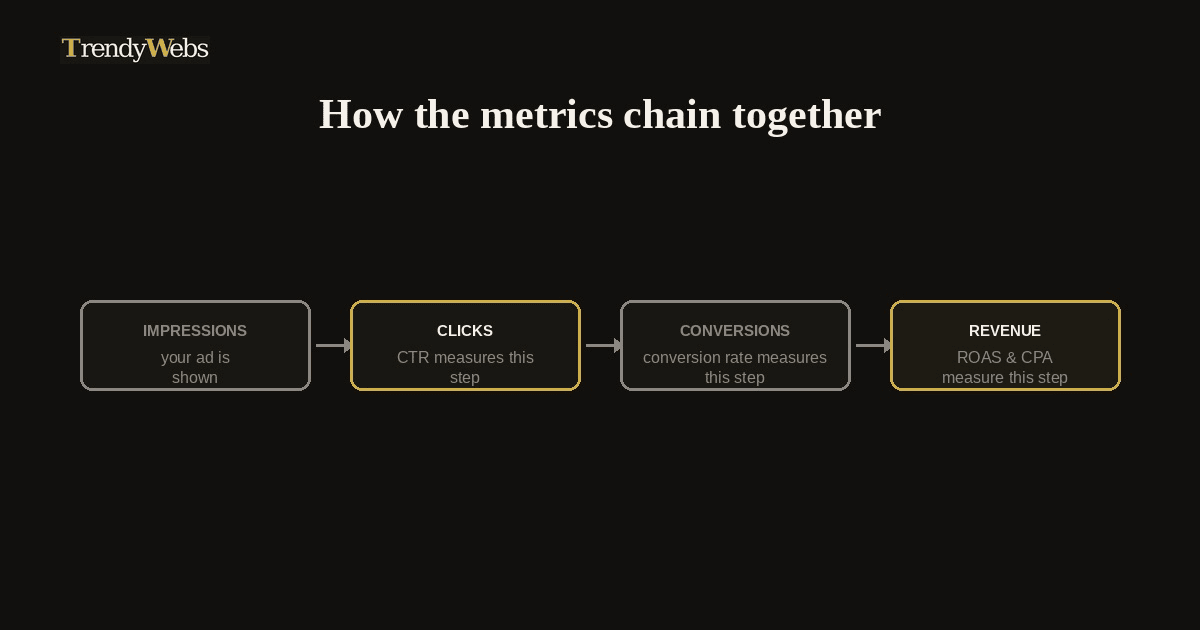
Most people running ads are staring at the wrong number.
Not because the numbers themselves are wrong, but because it's easy to watch the metrics that feel good instead of the ones that predict whether your business is growing. Here's a plain-language breakdown of what each core metric tells you, and where each one falls short on its own.
CTR tells you whether your ad is interesting enough to earn attention. It's the percentage of people who saw your ad and clicked it.
A high CTR is a good sign that your creative and targeting are aligned, but it doesn't tell you anything about what happened after the click. An ad can have an excellent CTR and still lose money if the landing page doesn't convert.
CPC tells you what that attention is costing you. It's calculated by dividing total spend by total clicks.
CPC is useful for understanding efficiency and competitiveness within your ad auction, but on its own it says nothing about quality. A cheap click from someone who was never going to buy is still a wasted click, just a cheaper one.
ROAS is the metric most people obsess over, and for good reason, it directly ties spend to revenue. But ROAS has a well-known blind spot: it's usually blended, meaning it counts revenue from repeat customers alongside revenue from people who found you for the first time.
A 5X blended ROAS can look impressive while hiding the fact that most of that return came from customers you already had. The number that predicts growth is new-customer ROAS, what you earn back specifically from first-time buyers. (We've written a full breakdown of this distinction, worth reading if ROAS is a number you report on regularly.)
CPA tells you what it costs to generate one conversion, a lead, a sale, a sign-up, whatever your defined goal is. This is often more directly useful than ROAS for lead-generation businesses where "revenue" isn't cleanly tied to a single transaction.
The key with CPA is making sure it's measured against a conversion event that matters to the business, not a proxy metric like "form submissions" if a large share of those forms never turn into real customers.
Conversion rate measures what percentage of people who reached your site or landing page completed the goal action. This metric often reveals problems that ad-level metrics can't. You can have a strong CTR, a reasonable CPC, and still a broken funnel if your conversion rate is low, the issue usually sits with the landing page, offer, or trust signals, not the ad itself.
Frequency measures how many times, on average, the same person has seen your ad. It's easy to overlook, but a rising frequency with a declining CTR is a clear sign of ad fatigue, and it's often the earliest warning that a creative refresh is needed before performance visibly drops.
None of these numbers mean much in isolation. CTR without conversion rate tells you people are curious but doesn't confirm they buy. ROAS without the new-customer split tells you the campaign is profitable but not whether it's growing the business. CPA without context on lead quality tells you cost, not value.
The real skill in running ads isn't optimizing any single metric. It's understanding which combination of numbers, read together, answers the question that matters: is this spend growing the business, or just making the dashboard look good?
Start with conversion rate. If it's low, no amount of CTR or CPC optimization will fix the underlying problem, the issue is likely downstream of the ad itself, on the landing page or offer.
Weekly at minimum for active campaigns, with a deeper monthly review that includes new-customer ROAS and CPA trends over time, not just a single snapshot.
At minimum, Google Analytics 4 with proper e-commerce or lead tracking, Meta Pixel (or Conversions API) if running Meta ads, and a way to tie ad platform data back to actual CRM or sales outcomes. Without that last link, you're optimizing for platform-reported numbers that may not reflect real business results.